SLICES OF A LIFE
Seven decades of images by Teekay
Diving in British Columbia in the 60's - the good old days!
Click on any photo
to see a larger version
In the early '60's scuba diving was starting to catch on big time in Vancouver
but bureaucracy and P.A.D.I. had not yet got the sport in its clutches.
Dive shops were unregulated and training was a lot more informal than today.
Totally hooked, I joined a unruly crowd, initially called the Wobbygongs
then later the Vanquatics, centered on a dive shop owned by
a crazy Aussie named Norm Liebeck. Some of our lot were among
the the first surfers to regularly ride the waves at Long Beach on Vancouver
Island, driving there all night on Fridays after work in battered "Wreck
Beach cars" over the rough and winding roads to what is now Pacific
Rim Park. Then, one could drive freely on the beaches there. In fact the
super-cheap, super-grungy, Singing Sands waterfront cabins
- the only affordable accommodation for most of us apart from tents - could
only be reached that way.
Scuba equipment was primitive by today's standards. No buoyancy vests, no
spare regulators for buddies - in fact usually no buddies. Sport divers
never wore dry suits, just plain black 1/4" neoprene wet suits. I used
low capacity steel tanks with no reserve valves. Decompression computers
and similar gizmos hadn't been invented, and I was one of the few who had
a pressure gauge hooked up to see how much air I had left.
These few images don't do justice to this whole other world that I miss very much, but sinus trouble won't let me return now to get better ones.
APOLOGIES! Most of the following images are very poor quality because they were originally shot on 16mm movie film, later converted to VHS tape, then more recently put onto a DVD and finally had the single frames extracted from the MPEG movie.
 I
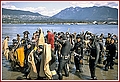
was a charter member of the now defunct VANQUATICS scuba club
which was the first to play underwater hockey in Canada. Very active, we organized
Vancouver's first annual garbage contest to clean up the waters off Stanley
Park. As shown here, it attracted a good crowd of divers carrying "goodie
bags".
I
was a charter member of the now defunct VANQUATICS scuba club
which was the first to play underwater hockey in Canada. Very active, we organized
Vancouver's first annual garbage contest to clean up the waters off Stanley
Park. As shown here, it attracted a good crowd of divers carrying "goodie
bags".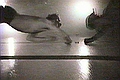 We
played u/w hockey once a week in the Renfrew pool. Not too popular with management
there since some makes of flippers in those days left black marks on the pool
floor. Our team had some very large and hairy members and I remember them
totally intimidating a Simon Fraser University team in their own home pool
- they looked like shrimps beside the Vanquatics men
We
played u/w hockey once a week in the Renfrew pool. Not too popular with management
there since some makes of flippers in those days left black marks on the pool
floor. Our team had some very large and hairy members and I remember them
totally intimidating a Simon Fraser University team in their own home pool
- they looked like shrimps beside the Vanquatics men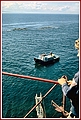 Most good dive spots - and there were plenty of them - could only be reached
by boat, so when I designed and built the 32' catamaran "Davy Jones"
for our family to explore the BC coast it incorporated underwater portholes
plus a diving ladder between the hulls. It is shown here moored off isolated
Sisters Island lighthouse the year before I fitted a mast and
sails (see also "Boats & Water" link on my Home Page)
Most good dive spots - and there were plenty of them - could only be reached
by boat, so when I designed and built the 32' catamaran "Davy Jones"
for our family to explore the BC coast it incorporated underwater portholes
plus a diving ladder between the hulls. It is shown here moored off isolated
Sisters Island lighthouse the year before I fitted a mast and
sails (see also "Boats & Water" link on my Home Page)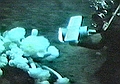 You
need a powerful light to make movies underwater, so I made one out of a car
spotlight and motorcycle battery in a heavy aluminum case, shown here lighting
up some white plumose anemones. It was the envy of all on night dives and
I eventually sold it to Jim Willoughby, a well known professional
diver. This was the only money I ever made with underwater movies, despite
high hopes
You
need a powerful light to make movies underwater, so I made one out of a car
spotlight and motorcycle battery in a heavy aluminum case, shown here lighting
up some white plumose anemones. It was the envy of all on night dives and
I eventually sold it to Jim Willoughby, a well known professional
diver. This was the only money I ever made with underwater movies, despite
high hopes Collecting
specimens for the Vancouver Aquarium was another part time business I tried.
On one occasion I actually earned money as an underwater "big game guide"
in the CBC TV show On the Scene with Bob Switzer as
Aquarium curator Vince Penfold and I captured a particularly
large octopus at Porteau Cove. The episode had thrilling James
Bond music in the background but was totally boring as all the action took
place underwater where TV couldn't go
Collecting
specimens for the Vancouver Aquarium was another part time business I tried.
On one occasion I actually earned money as an underwater "big game guide"
in the CBC TV show On the Scene with Bob Switzer as
Aquarium curator Vince Penfold and I captured a particularly
large octopus at Porteau Cove. The episode had thrilling James
Bond music in the background but was totally boring as all the action took
place underwater where TV couldn't go 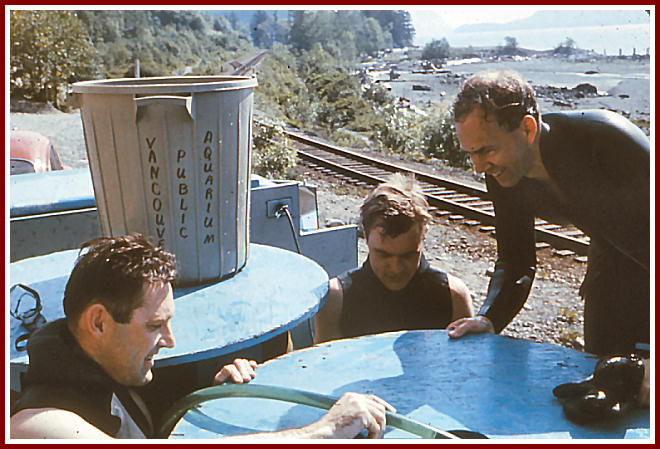 We
look happy but this is all CBC viewers saw of the giant octopus. We brought
it up in a garbage can and then transferred it quickly to this tank since
bright sunlight might have killed it. (L to R) Vince Penfold, Curator, Gil
Hewlett, Asst.Curator, and myself.
We
look happy but this is all CBC viewers saw of the giant octopus. We brought
it up in a garbage can and then transferred it quickly to this tank since
bright sunlight might have killed it. (L to R) Vince Penfold, Curator, Gil
Hewlett, Asst.Curator, and myself.
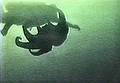 Other octopi. The middle image shows a diver tickling a big one
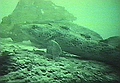 Ling cod were abundant then and made good eating. One of our Vanquatics members,
Gordie Cox, held the world spearfishing at that time with one
about 60 lbs. Then there was the legendary "Giant Ling of Pender Harbour",
reportedly living so deep and so huge that when divers glimpsed its cavernous
mouth they fled rather than be eaten themselves
Ling cod were abundant then and made good eating. One of our Vanquatics members,
Gordie Cox, held the world spearfishing at that time with one
about 60 lbs. Then there was the legendary "Giant Ling of Pender Harbour",
reportedly living so deep and so huge that when divers glimpsed its cavernous
mouth they fled rather than be eaten themselves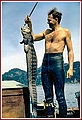 This
is an ecologically incorrect photo these days but spearfishing, rather than
photography, was popular then for most divers. Despite this macho type image,
I did it for meat, not sport. We had three boys with big appetites and Wolf
Eels like this are good eating
This
is an ecologically incorrect photo these days but spearfishing, rather than
photography, was popular then for most divers. Despite this macho type image,
I did it for meat, not sport. We had three boys with big appetites and Wolf
Eels like this are good eating 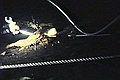 Some nights we dived for huge prawns like the one shown here - up to 18"
long from feelers to tail - that fed on the cluttered bottom deep under the
marina at Whitecliffe Park. A few of those collected for the
Aquarium late at night ended up being eaten by staff and us divers behind
the scenes before they made it to the display tanks. Whytecliffe, like Porteau
Cove, is now a protected marine park
Some nights we dived for huge prawns like the one shown here - up to 18"
long from feelers to tail - that fed on the cluttered bottom deep under the
marina at Whitecliffe Park. A few of those collected for the
Aquarium late at night ended up being eaten by staff and us divers behind
the scenes before they made it to the display tanks. Whytecliffe, like Porteau
Cove, is now a protected marine park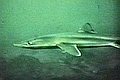
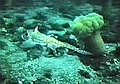
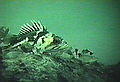 Dogfish
sharks like this are common in B.C. waters, as are Ratfish like the one in
the centre image and the Rockfish on the right, but only the latter is good
eating.
Dogfish
sharks like this are common in B.C. waters, as are Ratfish like the one in
the centre image and the Rockfish on the right, but only the latter is good
eating.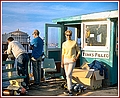 Once,
on a business trip to Los Angeles, I snuck off via seaplane to Catalina
Island for a day of diving where I was able to rent tanks from this
dive shack owner on the Avalon waterfront. The incredible clarity
and warmth of the blue water there was a huge contrast to the usually murky
green waters of the B.C. coast
Once,
on a business trip to Los Angeles, I snuck off via seaplane to Catalina
Island for a day of diving where I was able to rent tanks from this
dive shack owner on the Avalon waterfront. The incredible clarity
and warmth of the blue water there was a huge contrast to the usually murky
green waters of the B.C. coast 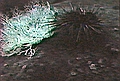
 This
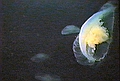
white basket star was a rare find at about 100' deep. Often the dark, clear
waters of Indian Arm, a long inlet near Vancouver, were filled
at all depths with delicately pulsing jellyfish of all shapes and sizes
This
white basket star was a rare find at about 100' deep. Often the dark, clear
waters of Indian Arm, a long inlet near Vancouver, were filled
at all depths with delicately pulsing jellyfish of all shapes and sizes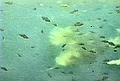 Sometimes, as in this final shot taken in a forest of giant kelp off Savary
Island, the water was thick with tiny life - marine soup
Sometimes, as in this final shot taken in a forest of giant kelp off Savary
Island, the water was thick with tiny life - marine soup