SLICES OF A LIFE
Seven
decades of images by Teekay
Boats and Marine
Living in Vancouver
we couldn't escape the call of the sea, and in the early 1960's I was finally
earning enough money to start thinking about building a boat of my own, although
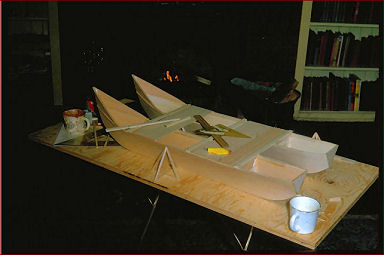
it had to be cheap. Catamarans and trimarans were becoming popular so I started
out by building this a scale model of balsa wood to test my simple design. It
floated and seemed strong, so next I built a 14 foot version.
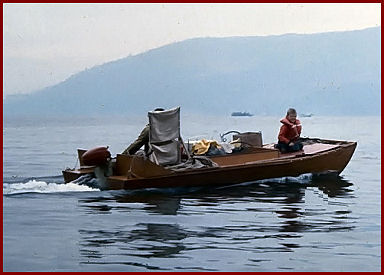
This plywood 14 footer
was one of a kind, incorporating several of my own ideas - some worked, some didn't.
The "accommodation" was just a flat deck amidships with a 6" edge
around to stop stuff sliding off. Power was a 10hp Johnson outboard.
The sail
was collapsible, plastic over aerofoil shaped ribs that slid up and down the mast.
Theoretically efficient, in practice this was not a success, and one time when
I hoisted it in Porlier Pass I was embarrassed by someone coming alongside to
see if I was in distress.
But it was an extremely safe and stable little
boat, and my friend Pete and I had many good times on it, fishing and exploring
Howe Sound in all weathers.
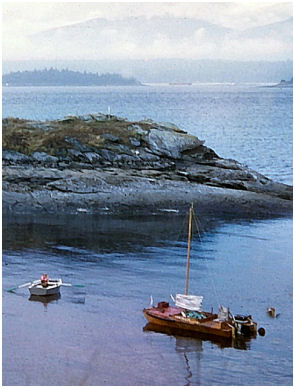
Here you see it moored up at Salishan resort,
Galiano Island, after two of us had crossed the Georgia Straight in quite rough,
cold weather after launching at Ladner. One of the boys is rowing one of the resort's
dinghies.
 Next I bought the 20 foot "Lisa Jane" cheap as a used fixer-upper from
Doug's Boats, a dry land boatyard in North Vancouver. It had a bit of dry rot
but I aimed to fix it up, get a bit of fun out of it, then sell it at a profit
to help finance my building a larger catamaran.
Next I bought the 20 foot "Lisa Jane" cheap as a used fixer-upper from
Doug's Boats, a dry land boatyard in North Vancouver. It had a bit of dry rot
but I aimed to fix it up, get a bit of fun out of it, then sell it at a profit
to help finance my building a larger catamaran.
Once in the water it turned
out to be an awful, dangerous boat. It was powered by a flat-head Ford V-8 that
gave off a powerful burble and got up to a good speed, but the hull had a basic
design flaw. It had a deep and sturdy skeg, which I had thought was good feature
to protect the naked propeller, but when the boat got up on plane it wanted to
lean to one side, not balance on the skeg, and in turns it rolled alarmingly outward
instead on inwards like it should. Here it is shown at Pebble Beach, Galiano Island,
on an overnight camping trip with Pam and Pete.
I sold it as fast as I
could.
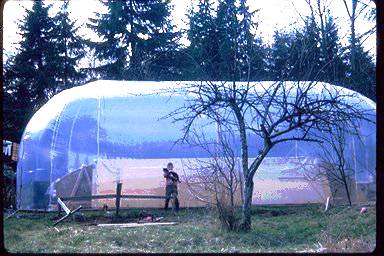 In 1964, in North Vancouver, I designed the Davy Jones, a 32' sailing
catamaran, and built it in "The Bubble".This monster in the backyard was kept
inflated by just a small, old car heater fan.
In 1964, in North Vancouver, I designed the Davy Jones, a 32' sailing
catamaran, and built it in "The Bubble".This monster in the backyard was kept
inflated by just a small, old car heater fan.
The bubble size was about 40'x20'.
It was cheap, only $33 for the plastic, but did attract a few vandals who wanted
to see what happened if punctured by a cigarette or knife - and it didn't do too
well in the snow. Building the boat took only 6 months, done after work and at
weekends.
It was hard going with just a 1/4" drill and a small sabre saw for
power tools - never again!

The first year we didn't have a mast or sails, just using the converted
VW motor with a long custom-made outboard "leg". Later, I felled a Douglas Fir
nearby, dragged it home behind the car during a gap in traffic, and dried it under
a smaller version of the "bubble". After endless planing. then rigging with thick
galvanized cables, I transported it, avoiding main roads, down to Mosquito Creek
marina on a small boat trailer with the mast precariously overhanging the car
in front and many feet behind the trailer.
Here Pete is helping me step
the mast for the first time. All went well, I had calculated the rigging lengths
right, and it finally stood strong and straight.

The Davy
Jones was not a pretty boat, but for four years, weekends and summer
holidays, it took our family all over the Gulf Islands of B.C. and Washington
and a fair way up the coast. Designed as a dive boat, it had underwater glass
viewports and a hatch and ladder between the hulls for easy diving access. Lots
of fish...many special places and people...hairy storms...hot days...good times
with the boys....
 Our three boys on board the Davy Jones in August '65, anchored at Sisters Island
lighthouse off Lasqueti Island in the northern Georgia Strait.
Our three boys on board the Davy Jones in August '65, anchored at Sisters Island
lighthouse off Lasqueti Island in the northern Georgia Strait.
The log records
that we were "greeted enthusiastically" by the light keepers, who rarely had visitors.
They started up the light and ear-splitting foghorn for the boys, served us coffee
and cookies, and swapped tall tales.
The diving here was superb, with crystal
clear water and abundant wildlife which provided supper for days. The largest
Wolf Eel shown here was found 60' deep and measured 6'4" long. The other eatables
on the cabin roof are large rock scallops and rockfish. All these are very good
eating, although the lightkeepers looked rather dubious when we presented them
with one of the Wolf Eels for their supper, together with some peaches we had
bought on Lasqueti.
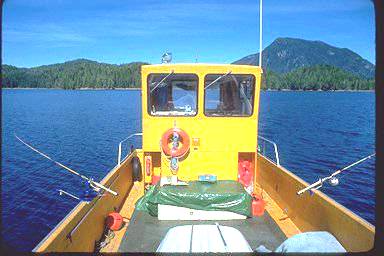 The 28 foot "Sea Truck 15" was a multi-purpose, fibreglass landing craft powered
by a big Mercruiser 255 and I had hoped to earn a good living with it in Ocean
Falls. It turned out there just wasn't enough business to make it profitable,
but it was great for fishing and SAR work. I practically lived off coho and spring
salmon for a while there when in "survival mode" after most of the town's population
had left due to the mill closure.
The 28 foot "Sea Truck 15" was a multi-purpose, fibreglass landing craft powered
by a big Mercruiser 255 and I had hoped to earn a good living with it in Ocean
Falls. It turned out there just wasn't enough business to make it profitable,
but it was great for fishing and SAR work. I practically lived off coho and spring
salmon for a while there when in "survival mode" after most of the town's population
had left due to the mill closure.
The Sea Truck, although not exactly
sleek looking, was capable of 30 knots with a light load, often surprising fancy
cabin cruisers trying to leave us in their wake. A gas-guzzler, it eventually
it had to be sold and went to a trucking company in Gibsons Landing. After that,
my salmon were caught cheaply but more precariously from a canoe.
Comments welcomed! Email me at  Click here for
my home page - "Slices of a Life - Seven decades of images by Teekay"
Click here for
my home page - "Slices of a Life - Seven decades of images by Teekay"
All images are
Copyright © 2004 Teekay and may not be reproduced without permission